.png)


The Great SEN Scandal: When a Legal Right Exists Only on Paper


"Your child has an EHCP."
For many families, those six words are not reassuring. Instead, they mark the beginning of a battle. A battle to secure an assessment. A battle to obtain a plan. A battle to get the provision written into that plan delivered. Then, somehow, a battle to enforce the very document that was supposed to bring the fighting to an end.
Welcome to the reality of the SEND system in 2026.
The uncomfortable truth is that the system is not struggling because there are suddenly too many children with special educational needs. Children did not suddenly become autistic. PDA did not suddenly appear. Children with speech and language difficulties, learning disabilities, sensory differences, mental health needs, and neurodevelopmental conditions have always existed. What has changed is that more families are recognising when their children need support and are less willing to accept that those children should simply struggle in silence. That increased awareness has exposed gaps that have existed for years.
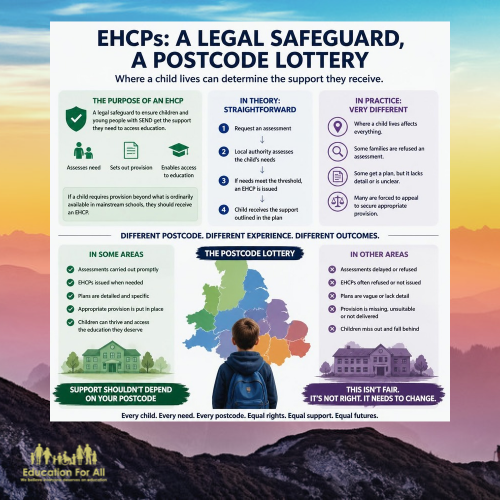
An EHCP is supposed to be a legal safeguard, ensuring that children receive the support they need to access education. In theory, the process is straightforward. If a child requires provision beyond what is ordinarily available in mainstream schools, they should receive an EHCP. In practice, however, many families experience something very different. Where a child lives can significantly influence whether they receive an assessment, whether a plan is issued, how detailed that plan is, and whether parents are forced to appeal to secure appropriate provision.
Two children can have remarkably similar needs yet receive entirely different outcomes. One may gain access to specialist support, while another is told their needs can be met through existing school resources. One family receives cooperation, while another faces refusal after refusal. The law is supposed to be consistent, but many parents describe the system as feeling like a postcode lottery.
At the heart of many disputes is a single word: need.
Not diagnosis. Not attendance. Not academic attainment. Need.
Once a need is formally identified, there is a legal obligation to provide support. That support requires resources, staffing, expertise, and funding. It is here that many families begin to notice a contradiction. Reports can describe a child as overwhelmed, highly anxious, struggling to access learning, experiencing distress, or unable to cope within their current environment. Yet when discussions move to provision, those same difficulties are often reframed as manageable, emerging, or capable of being addressed through ordinarily available resources.
Parents are left asking the obvious question: if the difficulties are significant enough to fill pages of professional reports, how do they suddenly become less significant when decisions about funding need to be made?

Attendance has become one of the most contested areas within the SEND landscape. For many years, attendance was viewed as a simple issue. Children either attended school or they did not. We now know the reality is often far more complex. Neurodivergent children may experience overwhelming anxiety, sensory overload, chronic stress, social exhaustion, autistic burnout, or nervous system dysregulation that makes attending school extremely difficult.
Yet despite growing understanding, many families continue to feel that attendance concerns are approached through a lens of blame. Parents are asked whether they have been firm enough, whether they have established clear enough boundaries, or whether sufficient consequences are in place at home. The underlying suggestion can be difficult to ignore: if a child is not attending school, somebody must not be trying hard enough.
Far less attention is given to a much more important question: what is making school feel unsafe, overwhelming, or inaccessible for this child?
This leads to another uncomfortable issue within the SEND system: parent blame.
Many parents become experts because they have no choice. They spend years attending appointments, reading research, completing training, seeking advice, gathering evidence, and learning legislation. They learn about autism, ADHD, PDA, sensory processing, anxiety, trauma, co-regulation, and educational law because their child's wellbeing depends on it.
Yet despite this accumulated knowledge, many parents report feeling dismissed when they raise concerns. Their observations may be described as exaggerated, anxiety-driven, or unrealistic. Some are made to feel as though their advocacy itself is the problem. Being repeatedly told that your concerns are not valid while watching your child struggle can be one of the most painful experiences a family faces.
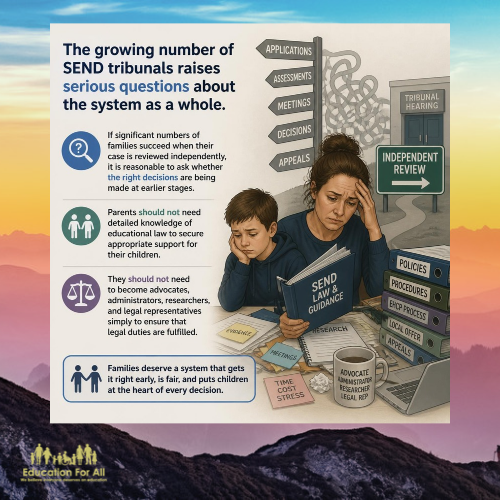
The growing number of SEND tribunals raises serious questions about the system as a whole. If significant numbers of families succeed when their case is reviewed independently, it is reasonable to ask whether the right decisions are being made at earlier stages. Parents should not need detailed knowledge of educational law to secure appropriate support for their children. They should not need to become advocates, administrators, researchers, and legal representatives simply to ensure that legal duties are fulfilled.
Tribunals were intended to be a safeguard when disagreements occur. For many families, they have become an expected part of the journey.
When discussions focus on SEND, attention is often directed towards finances. We hear about high-needs budgets, specialist placements, transport costs, staffing shortages, and funding pressures. These challenges are very real. However, there is another cost that rarely appears in official reports.
There is the parent who gives up employment to manage appointments and school meetings. The family living with constant stress and uncertainty. The siblings whose lives are affected by ongoing battles. The young person who begins to internalise the message that they are the problem. There is an enormous human cost attached to a system that too often places families in a position where they must fight for support that should not require a fight at all.
Perhaps the most important question is whether increasing numbers of children struggling within education tells us something about the children or something about the system itself.
What if anxiety is not the problem but a warning sign? What if school avoidance is communication? What if burnout is communication? What if demand avoidance reflects a child experiencing a world that feels overwhelming, unsafe, and beyond their control? What if the issue is not that children are failing to fit into the education system, but that parts of the education system are failing to adapt to the diversity of children it serves?
These are uncomfortable questions because they require us to rethink long-held assumptions.
The debate around SEND is often presented as a conflict between parents and local authorities, but that framing misses the bigger issue. The real question is not whether there are too many EHCPs. It is not whether needs have increased. It is not even whether budgets are under pressure.
The real question is this:

How many children are currently paying the price for a system that knows what they need but cannot, or will not, provide it?
Until that question is answered honestly, families will continue to fight, tribunals will continue to rise, and trust in the system will continue to erode.
Because an EHCP was never meant to be a prize won through persistence and conflict.
It was meant to be a safeguard.
For far too many families, it has become evidence of a promise that exists only on paper.


Comments